
The real challenge is the experience around the courts
Most tennis clubs do not lose players because the tennis is poor. They lose them because the club feels harder to use than it should.
Need the software layer? Tennivo gives clubs dedicated tennis club management software for court bookings, member management, payments, invoices, tournaments, and reports in one dashboard.
A new player finds the club, sends a message, waits for a reply, asks how bookings work, joins a crowded group chat, and tries to figure out who is available to play. Motivated players push through. Casual players often disappear before the club has a chance to retain them.
Modern tennis club management is about making the path clear: find the club, join, book, play, compete, communicate, and come back.
Why players leave
Players rarely leave because of one dramatic problem. Small frictions stack up.
Booking a court should not require texting an admin. Membership approval should not feel unclear. Social play should not depend on already knowing the right people. Tournament updates should not be buried in a group chat.
When those basics are messy, players do not always complain. They simply play less.
The scattered tools problem
Many clubs run on a patchwork: one spreadsheet for members, another for bookings, a shared calendar for coaches, WhatsApp for announcements, and a separate file for payments.
Each tool may work on its own, but together they create hidden admin work. Information gets copied between places. Nobody is sure which version is current. The person who "knows the system" becomes a single point of failure.
The goal is not more software. It is fewer disconnected workflows.
What a well-run club needs
Clear roles
Admins, coaches, staff, trusted players, and regular members need different access. Coaches need lesson schedules. Trusted players may book courts directly. New members may need approval before getting full privileges.
Clear roles keep the club organized as it grows.
A reliable booking calendar
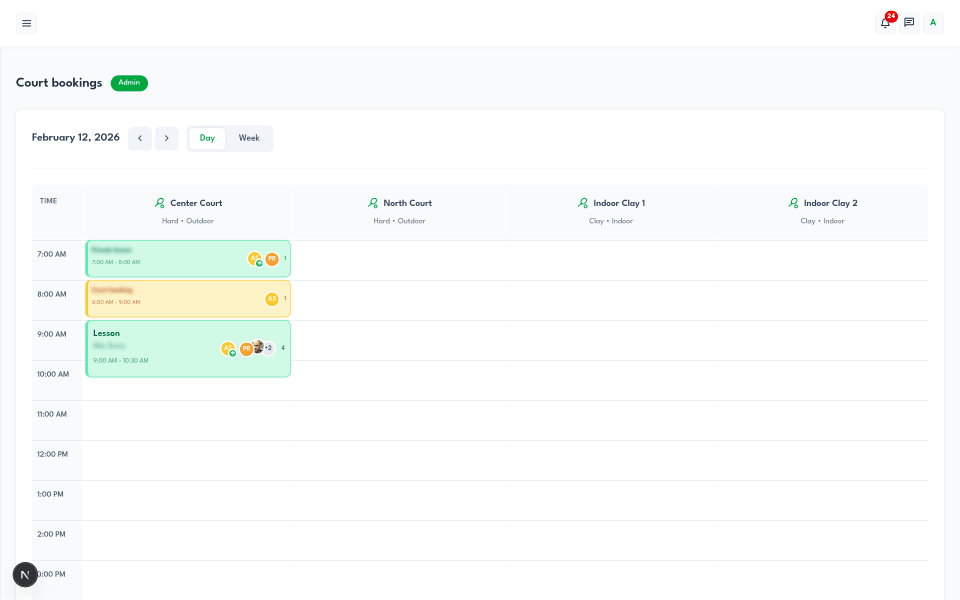
Court booking is the workflow members feel most often. A good calendar shows real-time availability, prevents overlapping bookings, supports day and week views, and handles court reservations, lessons, recurring sessions, private blocks, and open sessions.
The point is not only to display bookings. It is to remove routine back-and-forth while keeping the club in control.
Member management beyond a contact list
A spreadsheet can store names. It cannot show who is active, pending, trusted, invited, or drifting away.
Useful member management should show role, status, skill level, trusted status, onboarding state, and activity. Admins should be able to approve requests, invite players, add existing users, and create accounts manually when needed.
This is where retention becomes practical. If a regular member has not booked in a month, the club can see it early enough to follow up.
Communication that does not get buried
Group chats are fine for social conversation, but they are not a reliable place for official club operations.
Booking changes, membership updates, tournament messages, and club announcements should reach the right people automatically. The official record should not depend on someone scrolling back through messages.
Events that are easy to run
Tournaments, ladders, and social sessions keep players engaged. They give people reasons to show up and help new members meet others.
The problem is admin effort. Registrations, brackets, match schedules, scores, and standings are painful in spreadsheets. A modern system should make regular events realistic, not heroic.
Billing connected to activity
Invoices and coach reports should follow the data already in the booking calendar. If a lesson happened, the hours and participants should already be available. If a member booked sessions during the month, invoices should not require manual reconstruction.
Online payments can also help, but they should be optional. Some clubs need Stripe card payments for public bookings. Others want to start with scheduling and invoicing first.
Online discovery is part of management
Players search before they visit. A useful club profile should show courts, surfaces, amenities, photos, location, and a clear next step: request membership, contact the club, or book a court when online payments are enabled.
This is not just marketing. It is the front door to the club.
Modernize gradually
The best rollout is usually simple:
First: make the club easy to find online.
Next: move bookings into a proper calendar.
Then: clean up members, roles, and communication.
After that: add tournaments, invoices, coach reports, analytics, and online payments when the club is ready.
Gradual adoption works because clubs are communities, not software teams. Each step should solve a real problem and make the next step easier.
What better management feels like
A new player finds your club, understands what you offer, requests membership, gets approved, completes onboarding, and books a first session without confusion. Later, they join an open doubles session, enter a tournament, receive clear updates, and become part of the club's rhythm.
The tennis is the same. The experience around it is better.
Modernize your tennis club with Tennivo
Tennivo helps clubs manage public profiles, court bookings, members, trusted players, coaches, tournaments, rankings, invoices, coach reports, club news, messaging, analytics, and optional online payments.
Tennivo is free for clubs, with every feature and no member limit. There is no subscription, and online payments go to the club's own Stripe account.
Start managing your tennis club today
Organize bookings, members, events, billing, and communication in one tennis-specific platform.
Get started free ›No credit card required
Frequently asked questions
What is tennis club management software?
It is software for managing the operational side of a tennis club: members, bookings, coaches, events, communication, billing, and reporting.
What should a tennis club digitize first?
Start with the workflow causing the most friction. For most clubs, that is court booking. For others, it may be member management or online discovery.
How can clubs improve retention?
Make booking easy, onboard new members clearly, run regular events, and track activity so the club can follow up before players drift away.
Should clubs automate everything at once?
No. A gradual rollout is more professional and easier to adopt. Fix one workflow, prove the value, then expand.
Tags:
Related posts
Tennis club booking system: how to automate court reservations in 2026
A practical guide to tennis court booking systems: calendars, conflict prevention, permissions, booking types, recurring sessions, and payments.

Tennis club player retention: 7 strategies that keep members playing
Practical retention strategies for tennis clubs: reduce booking friction, onboard new players, use trusted status, run events, and spot inactivity early.
Search posts
Start managing your tennis club today
Join hundreds of clubs using Tennivo to streamline operations and grow their community
Get started freeNo credit card required