When tennis clubs start looking for management software, they usually begin with a feature checklist. The longer the list, the better the platform — or so the thinking goes.
In reality, the clubs that end up abandoning their software within a year almost always chose the platform with the most features. They got overwhelmed, their staff never fully adopted it, and six months later they were back to WhatsApp and spreadsheets.
The right question isn't "which platform does the most?" It's "which platform solves our actual problems without creating new ones?"
Before you evaluate any software, be honest about what's actually broken at your club right now. For most clubs, it falls into one of three categories.
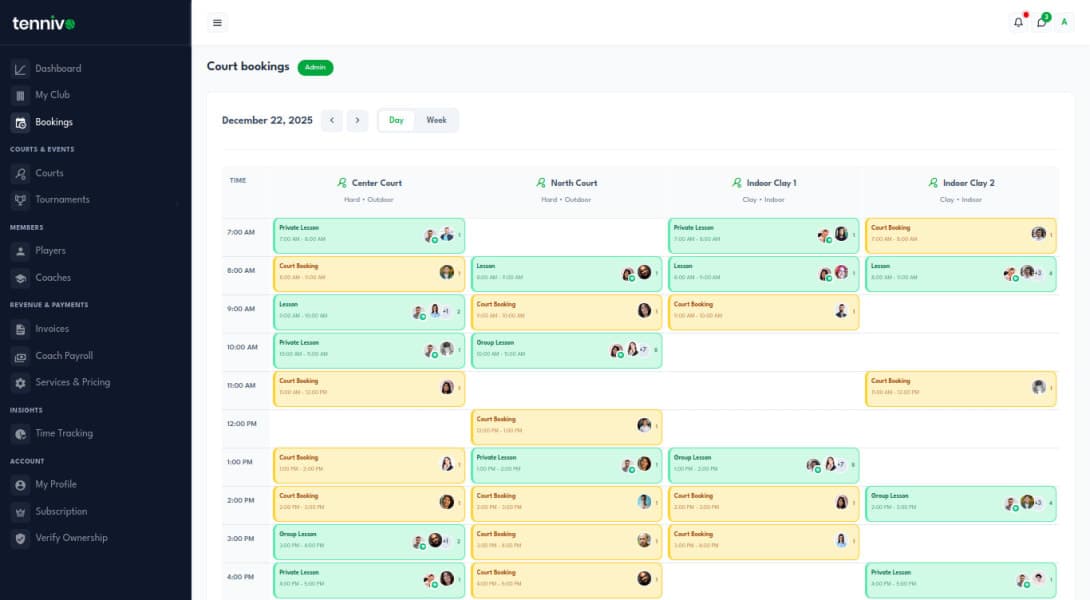
Court booking chaos. Double bookings, unclear availability, players texting admins to reserve courts, no record of who booked what. If this sounds familiar, your first priority is a booking calendar with real-time availability, overlap prevention, and role-based permissions — so trusted members can book directly while new players go through the right channels.
Member management is a mess. Player lists scattered across spreadsheets, no clear onboarding process for new members, no visibility into who's active and who's drifted away. You need a centralized member directory with roles, approval workflows, and activity tracking.
Tournaments are too much work. You want to run internal competitions but the manual effort — brackets, scheduling, scores, standings — means you only do it once or twice a year. The right platform handles bracket generation, match scheduling, score entry, and even ranking points automatically.
Start with the category that hurts the most. A platform that solves your primary problem well is infinitely more valuable than one that claims to solve everything but does nothing deeply.
This is the feature most clubs don't think to ask about — and the one that prevents the most headaches.
A good platform lets you define who can do what. Club administrators manage settings, approve members, and oversee everything. Coaches access their schedules and students. Trusted players book courts independently. New members have limited access until they're approved.
Without this, you get the same chaos you had before — just in a digital form. Everyone can see everything, book anything, and nobody knows who changed what. Role-based access sounds boring. In practice, it's the difference between a platform that scales with your club and one that creates new arguments.
Every tennis club management platform has "court booking." The differences are in the details.
Look for overlap detection that actually prevents double bookings rather than just flagging them after the fact. Look for a visual calendar — day and week views — where clicking an empty slot starts a booking with the time pre-filled. Check whether the system supports different booking types: open play, private lessons, group sessions, court-only reservations.
Most importantly, check whether booking permissions are tied to member roles. Can you restrict booking to approved members only? Can trusted players book directly while others require admin confirmation? Can coaches be assigned as instructors for specific sessions? These aren't edge cases — they're how real clubs operate every day.
A spreadsheet is a contact list. Club management software should be more than that.
You should be able to see all your members in one place — with their role, skill level, membership status, and activity history. You need an approval workflow for new membership requests, not just a manual add. You should be able to search for existing platform users and invite them, or create accounts for members who aren't tech-savvy — like junior players whose parents handle registration.
The real value shows up over time. When you can see at a glance which members are active and which haven't booked in weeks, you can re-engage people before they quietly leave. That visibility alone can transform your retention rate.
This is where many platforms either shine or fall apart. Running tournaments manually is one of the most time-consuming tasks in club administration. The right software should make it almost effortless.
Look for support for multiple formats: elimination brackets (8 to 64 players), round-robin groups, and hybrid formats where groups feed into knockout rounds. Registration management should include the ability to open and close registration periods, approve entries, manage waitlists, and set skill-level restrictions so competitions are fair.
Once the tournament starts, the platform should handle bracket generation, match scheduling with court assignments, set-by-set score tracking, walkovers, and automatic standings calculation for group stages. Bonus points if completing a competition automatically awards ranking points that players can track over time — that turns a one-off event into an ongoing engagement tool.
Not every club needs invoicing on day one, but when you do, it should be built in — not bolted on.
Good club management software lets you generate invoices for members based on their bookings and lessons, preview them before sending, record payments (full or partial), and export professional PDFs. If you employ coaches, you'll also want a payables system that tracks hours taught, calculates earnings, and generates reports per billing period.
The key is that these financial tools pull data from the same system where bookings and lessons live. No re-entering data, no reconciling between platforms.
If your club still relies on WhatsApp groups for announcements, you know the problem: important messages get buried under casual conversation within hours.
Built-in messaging — direct messages between members, club-wide announcements, and group conversations — keeps communication organized and in context. Notifications for booking changes, membership approvals, tournament updates, and waitlist promotions reach the right people at the right time, without anyone having to manually send messages.
This surprises people, but for many clubs — especially traditional ones or those in early stages of digital adoption — forcing online payments is the fastest way to kill adoption. Members push back, admins feel pressured, and the whole transition stalls.
The best platforms let you manage bookings, track who owes what, and generate invoices without mandating that payments flow through the system. You can add online payments later when your club is ready. Starting with structure and adding payments gradually works far better than the other way around.
Some platforms pitch sophisticated AI dashboards and predictive analytics. In practice, most clubs need to answer much simpler questions first: How many active members do I have? Which courts are most used? How many bookings happened this month? Who hasn't shown up in a while?
Basic, reliable analytics that answer these questions clearly are worth more than flashy dashboards that require a data science degree to interpret. Get the fundamentals right before worrying about AI.
A long list of integrations looks impressive on a marketing page. In reality, most clubs use two or three at most — usually a maps integration for their address and maybe an email service for notifications. The rest sit unused.
What matters more is whether the platform itself is self-contained enough that you don't need external tools for core functions. If you need a separate app for booking, another for communication, and a third for tournaments, that's not a platform — it's a bundle of tools with the same fragmentation problem you already had.
This is the most important question. A platform that forces you to set up every feature before you can use any of them is designed for the vendor's onboarding flow, not your club's reality.
The best approach is tiered: start with a club profile for visibility, add court bookings and member management when you're ready, then expand into tournaments, invoicing, and analytics as your needs grow. If the platform requires full commitment upfront, walk away.
Free trials are standard, but the length and scope vary dramatically. A 14-day trial for a tennis club is essentially useless — you need time to set up your club, invite members, test the booking flow, and see if the system works during a busy weekend. Look for trials of at least a month, ideally longer.
Also check whether there's a genuinely free plan for clubs that just want a basic online presence. A club profile that shows up in search results, displays your courts and amenities, and lets players find you — without paying anything — is a meaningful starting point that lets you evaluate the platform with zero risk.
General-purpose club management software — designed for gyms, yoga studios, and sports clubs broadly — will always feel like a compromise for tennis. Court-based scheduling, NTRP skill levels, tournament brackets, doubles partner matching, match formats like best-of-three sets versus super tiebreaks — these are tennis-specific needs that generic platforms handle poorly or not at all.
A platform built specifically for tennis understands that a "booking" at a tennis club is fundamentally different from a class at a yoga studio. The terminology, workflows, and features should feel native to how tennis clubs actually operate.
Management software shouldn't just help you run your club — it should help players find you. Check whether the platform offers public club profiles that appear in search results, whether players can discover your club by searching for city, proximity, or amenities, and whether your club page showcases what makes you worth joining.
In 2026, a club without a proper online profile is invisible to the majority of new players who search for clubs on their phone. Your management platform should double as your digital storefront.
No free trial or an unreasonably short one. Tennis clubs can't evaluate software in a week. If the vendor won't give you adequate time to test with real members and real bookings, they're not confident in their product.
Per-member pricing that scales aggressively. Some platforms charge per member per month, which sounds cheap until you have 200 members. Calculate the real cost at your current size and your projected size in two years.
Locked-in annual contracts with no exit clause. Monthly billing or reasonable cancellation terms show confidence. A platform that needs a contract to keep you is a platform that expects you might want to leave.
Feature lists without depth. "Court booking" can mean a simple calendar view or a full system with overlap detection, role-based permissions, service types, and instructor assignments. Always dig into what a feature actually includes, not just that it exists.
No mobile experience. Your members will book courts, check schedules, and follow tournament results from their phones. If the platform doesn't work well on mobile, it won't get used.
Imagine this: a player in your city searches for tennis clubs nearby. Your club shows up with photos, court details, amenities, and a "request membership" button. They sign up, you approve them, and they're immediately in your member directory with the right access level.
They browse the booking calendar, find an open court on Saturday morning, and reserve it in two taps. No texts, no waiting. Your admin sees the booking in real time with a full audit trail.
A month later, that player enters your club's monthly singles tournament. They register through the platform, the bracket is generated automatically, matches are scheduled with court assignments, and scores are tracked live. They finish third, earn ranking points, and check the leaderboard to see where they stand.
Meanwhile, the club admin generates invoices for the month's bookings, pays coaches based on automatically tracked hours, and spots a handful of members who haven't booked in three weeks — so they send a quick message inviting them to next Friday's open doubles session.
That's not a futuristic vision. That's what the right software makes possible today.
Tennivo is a tennis club management platform built specifically for tennis — from court bookings and member management to tournaments with automatic brackets and ranking points. Every club starts with a free profile and a 6-month free trial on all plans.
No forced complexity. Start with what you need, expand when you're ready.
Claim or add your club on Tennivo | View plans and pricing
It's a platform that replaces the collection of spreadsheets, group chats, and paper calendars most clubs use to run their operations. A good one handles court bookings, member management, tournaments, communication, and financial tracking in one system — designed specifically for how tennis clubs work.
Pricing varies widely. Some platforms charge per member (which gets expensive as you grow), others have flat monthly tiers based on features. Look for platforms that offer a meaningful free tier or long trial periods — at minimum a month, ideally several. Tennivo offers a free Visibility plan and a 6-month free trial on Starter and Pro plans.
You should be able to. Any platform worth considering offers a free trial long enough to actually test it with real members and real bookings. A 7-day or 14-day trial is too short for a tennis club — you need at least a few weekends to properly evaluate the booking flow, member onboarding, and overall experience.
Generic software is built for gyms, studios, and multi-sport facilities. It handles classes and memberships but doesn't understand court-based scheduling, tennis skill levels (NTRP), tournament brackets with elimination and round-robin formats, doubles partner matching, or match scoring. Tennis-specific software is built around these concepts natively, so the workflows feel natural rather than forced.
No — and you shouldn't try. The most successful digital transitions start with one pain point (usually court bookings or member management), get the team comfortable, and then expand. Platforms that let you adopt features gradually have much higher long-term adoption rates than those that require a full setup before you can use anything.

A practical guide to managing your tennis club online — from court bookings and member management to tournaments and communication, without overcomplicating things.
Join hundreds of clubs using Tennivo to streamline operations and grow their community
Get started freeNo credit card required